Slow-blow fuses or Soft Start
A toroidal transformer draws a high inrush current. A fast circuit breaker can trip even when the transformer is sound.

Everything customers ask most often about toroidal transformers, with tips from our workshop.
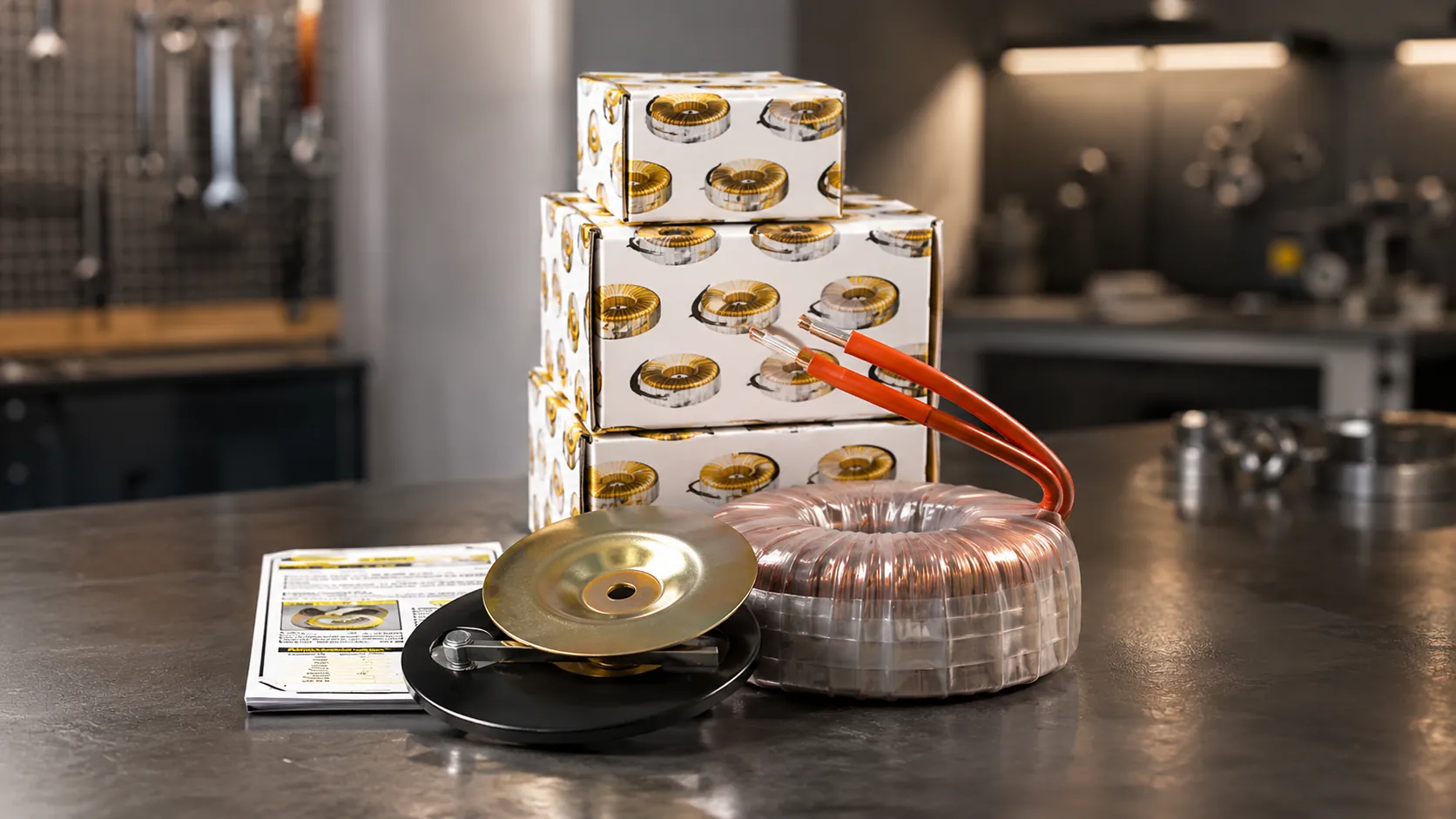
A transformer is an electrical device that converts one value of AC input voltage into another, required value of AC output voltage.
Transformers can be classified in several ways:
More detailed classifications by other parameters are also possible.
A toroidal transformer does the same job as other transformers, but it also has advantages:
In power supply units, rectifiers, voltage stabilisers and inverters. More specifically: in lift control panels, for controlling electric locks, in alarm control panels, for powering CCTV cameras, in audio equipment and battery chargers, for powering relays and contactors in control units, and in medical devices.
They are also used for halogen lighting, swimming pool lighting and inspection pit lighting in garages, and for connecting equipment from regions where the mains voltage is not 230 V, for example 110 V equipment from the USA or Canada.
It is an insulating film with a breakdown voltage of approximately 3500 V. It insulates the transformer from the mounting surface and protects the user from electric shock if they touch it. Do not remove or damage the film.
At full load and a room temperature of 20 °C, Trafco transformers operate at 65 to 75 °C, depending on the power rating.
The transformer has a built-in thermal fuse that disconnects it when the temperature exceeds the value rated on the fuse. This protects both the transformer and the equipment. Trafco transformers have a thermal fuse that trips at 115–130 °C.
Some thermal fuses reset automatically when the transformer cools down after an overload. Trafco fits one-shot fusible thermal fuses that we replace in our workshop, so that we can find the cause of the overheating.
It is a transformer whose primary and secondary windings are wound separately and insulated from each other. It is also called a safety transformer: there is no live phase at its output, so it protects people from electric shock and its serious consequences. It is mandatory for medical equipment and for lighting in vehicle repair workshops. Isolation transformers
An autotransformer, also known as a step-up or step-down transformer, has just one winding, tapped at the appropriate points. Its outputs carry the live phase, so it offers no protection. It is often used to supply 110–120 V equipment designed for direct connection to the live phase without danger to the user. Autotransformers
Yes. A three-phase transformer is made from three single-phase transformers connected in star or delta.
At switch-on, toroidal transformers draw a large inrush current while the core magnetises. Especially at higher power ratings, this can blow the fuse even when the transformer is in perfect working order. Use only slow-blow fuses or a soft-start circuit such as Soft Start.
No, never. A wire around the transformer forms a shorted turn that heats the transformer at that point, and after a while the transformer burns out. Use plastic cable ties instead of wire. We recommend the original mounting kit.
An electrostatic screen is a winding between the primary and secondary with one end connected to earth. It reduces radiation and gives extra protection against electric shock if the insulation between primary and secondary breaks down.
Yes. A correctly sized transformer can run continuously at full load in its intended operating mode, practically indefinitely.
The voltage under load is measured with a load connected to the transformer, and the no-load voltage with no load connected. The difference comes from losses in the transformer: the voltage under load can be a few per cent lower. The voltage drop for every standard power rating is listed in the price list.
The warranty lasts 12 months from the date of receipt, provided that the primary voltage does not deviate by more than ±5 % from the rated value. Terms and exclusions are on the Quality page.
Yes. We have been building and repairing toroidal transformers since 1990. We replace a blown thermal fuse at minimal cost and return the undamaged transformer to service.
A cardboard box sized to the transformer, a mounting kit (rubber washers, metal clamping plate, bolt with nut and washers) and instructions for use. The mounting kit is included in the price.
Soft Start limits the inrush current when the transformer is switched on. It is recommended for transformers rated 300–3000 VA with a 220 V primary. The unit’s operating voltage is 180–240 V and its maximum current is 16 A. Soft Start details
Yes, we ship worldwide, from a single unit to a full series. Write to us at office@trafco.rs.
The most common causes of failure we see in our workshop, and how to avoid them.
A toroidal transformer draws a high inrush current. A fast circuit breaker can trip even when the transformer is sound.
A wire through the centre hole and around the transformer forms a shorted turn. Use the original mounting kit or plastic cable ties.
The insulating film protects against electric shock (breakdown voltage approx. 3500 V). Removing it voids the warranty.
A primary voltage more than 5 % above the rated value heats the transformer and can trip the thermal fuse.
High ambient temperature, overload and short circuits are the most common causes of overheating.
Bring the transformer to us. We replace the fuse in our workshop and find the cause, at minimal cost.
The no-load voltage is a few per cent higher than the voltage under load. The voltage drop for each power rating is in the price list.
Humidity, temperature and fumes affect the choice of design. Mention them in your enquiry.
Regulations require galvanic isolation for medical devices. Choose an isolation transformer.
Write to us and we will reply as soon as possible.